Tuesday, July 7, 2009

Namibia - Himba Tribe

Two Himba women


Namibia, which is just north and towards the west of South Africa, had some of the most interesting tribes and spectacular natural sites to see. If you do not mind long car rides and sleeping on the ground inside a tent, then Namibia should be on your list of must see countries.

One particularly notable tribe is the Himba tribe. The members of this tribe live in a homestead that is "gated" by tree branches. All of the mud huts are within the circular gate. The tribe breeds cows and goats. All parts of these animals are used in some shape or form. For example, the walls of the mud huts are actually made of cow manure.

Backside of Himba womenGroup of Himba women


Female members of this tribe are very easy to spot. The women have a very distinct appearance. They cover their bodies, including their hair and clothing, with butterfat and ochre powder. This gives them the reddish appearance from head to toe. This protects their skin from the sun as well as acts as a moisturizer. Instead of using water to bathe, the women stand with their legs apart over burning incense. Their limited clothing of course is made out of cow or goat skin.

Himba children

The children wear special jewelry and hairstyles. Both of these tell the age of the child. An infant has his/her head completely shaved and he/she wears a beaded necklace. As the infant grows older, the number of hair braids in front and back gives away the child's age. The type and design of the necklace and bracelets tell the age and family of the child. Since cows and goats are very important to the sustainability of the Himba people, the children must from an early age learn to tend to them. Therefore, the children are often given the responsibility of learning to care for the small goats at first. Watching a 5 year old take his kid to graze is a sight to be seen.meat
dancing

On the day that I visited, the entire Himba homestead was having a celebration. The women were dancing. The men were sitting around watching. There was a big slab of meat on a fire. There was also what looked like a skinned animal up high in a tree. The dead animal is placed in the tree so that no other animals will get to it and eat it. This allows them to eat the meat at a slightly later time. Honestly, I could not imagine eating this meat. Without refrigeration it looked rancid. Their stomachs must be used to eating older meat that has been sitting in the sun.

men with leader

In order to gain entry to this homestead our group of 9 brought a gift. I believe we brought a big sack of rice as well as something else that would be useful for all. These items were given by our tour guide to the Himba tribe leader, who is sitting in the chair on the right. The leader must approve before we can visit. Once the leader approved, we were permitted to enter the gated homestead. After we walked around for a little while, the leader formally met us in front of the entire tribe. What was shocking was that he then asked for money to buy alcohol for the celebration. Our whole group was flabbergasted. We did not know what to do. We were being put on the spot and I was looking for our guide to jump in. If more of a gift was needed, our guide should have known to bring it. Our guide did nothing. Each group member including myself handed over a very small sum of money. This last interaction really tainted our experience.

That night we slept in tents outside of the homestead. The next day our group was invited back into the homestead. We collectively decided to skip our second visit. Our first visit was not exactly the exchange we had in mind.

S. Africa - De Beers Diamonds

De Beer diamon mine

One thing that South Africa is known for is its mining of both diamonds and gold. Kimberley is the location of South Africa's first diamond mine, which was the original headquarters of the now world famous De Beers. Diamonds were first discovered in Kimberley in 1867, but it was not until 1870 that Nicolaas de Beers found diamonds on his farm. News of the existence of diamonds caused an absolute frenzy with hundreds of families taking over Kimberley in search of diamonds. Today there are 6 major diamond mines in South Africa. I was fortunate to be able to go down into the Kimberley Mine.

Abigail 870m below

When I say that I went down into the Kimberley Mine, I mean that I went 870 meters (2,854 feet) or a little over half a mile below the surface. Before I could do that I needed to gear up and go through some safety procedures. I also had to sign a paper stating that anything found in the mine is the property of De Beers (Darn!!).


mining


I was told a mine usually takes about 7 years to build and then about 10 years to mine. The diamonds are found in kimberlite rock. Through pressure and dynamite the rocks fall. Large machinery is used to scoop up the large rocks and place them into a barrel. The barrel is pushed down the tracks to a conveyor belt. The conveyor belt moves the large rocks into a crushing machine, where the large rocks become small stones. Another conveyor belt catches the stones and moves them to the top of the mine.

My tour guide was very excited for me to hear the dynamite. He could not wait to see my reaction. Unfortunately or fortunately for me one of the main conveyor belts broke. Production had to stop until the belt was fixed, which would take several hours. Therefore, I did not get to experience a dynamite blast underground only hundreds of feet away from me.

rescue roomOne part of the tour that I found fascinating was the emergency procedures. When dynamite is set off, there is always a potential for catastrophe. There can also be a fire underground, an earthquake, or water seepage that can cause a mudslide. When these things happen, you have to run like a maniac to safety. When you are half a mile underground, you are not likely to make it to the elevator in time to get out. There are many, many tunnels. It is a maze down there. Therefore, there are several rescue rooms. If you can not get to the elevator, you are to try and get to one of the rescue rooms. One of the challenges is that the lights underground may go out. It could be pitch black. You may not be able to see your hand in front of you. With this in mind the mine has hanging poles that are there to basically smack you in the face. When you hit one of these, you know the door to the rescue room is on one of the sides. Once safely inside of the resouce room, you will find food, water, lamps, oxygen, and a radio communication system. You can survive in a rescue room for many days.

diamond separationOnce my tour was over, I went to the museum that explains the diamond mining process in detail. After the stones are brought to the surface, the stones are rinsed. Next the stones are placed on a special machine. This machine has a belt with oil on it. The diamonds stick to the oily belt and all other sediments fall off. This is how the diamonds get separated from the other materials.


jewelry makingOnce the diamond is separated from the other sediments, it is sent off to someone to cut it into jewelry. It usually takes about a 12 foot by 12 foot room worth of rock and dirt to mine a single carat of diamond. That's a lot of rock and dirt for just 1 wedding ring.

In addition to the diamond mine tour and the museum, there is an outdoor historic small town that can be walked through in Kimberley. It looks like a town from an old western. It has a bar as well as places that people would go to weigh their diamonds and stake their claim. It was interesting to walk through and try to imagine what it was like back in 1890 or so.

For me Kimberley, South Africa was completely out of my way and was not part of my original plan. I did not have a car and Kimberley was in the opposite direction of Kruger National Park. I definitely think I made the right decision to hop on the bus and take a couple of days to view the diamond mine. It was well worth a visit to see something I would never get to see in the States.

Monday, July 6, 2009

Indonesia - Holding Hands

Abigail and 3 young womenOn the bus ride from Yogyakarta, Indonesia I met a young Muslim woman, who wore a typical veil that covered her hair and around her chin (see picture - women on the right). She was returning from university to her parent's home. This young woman spoke excellent English. We talked a great deal during the bus ride. Eventually she asked me to come meet her family. Wow, this was a special invitation. Most English conversations that I had in Asia were with males, since they were the ones fortunate enough to have a formal education. The invitations I received by most males, I could not accept. My gut often told me that there was more to those invitations than a cup of tea. So this invitation was extra special, since I felt that I could accept it from this highly educated Muslim woman. We got off the bus. I tossed on my big blue North Face backpack and followed her home.

When I got to her home, I was a bit self-conscious. I was not dressed appropriately to meet her family, especially her parents. What was wrong? My legs were showing. Fortunately, I always carried a wrap for just these occasions. I pulled my wrap out from my backpack and wrapped it around my waist. I made sure it touched the top of my sandals, hoping to cover my ankles as well. Now I was ready to enter her home.

I am not sure if this young Muslim woman brought people home often or I was a unique guest. First she announced my presence and then I was asked to come in. When I walked through the door, her parents, brother, and younger sister were all very welcoming. Since this took place in 1996, I can not remember if they all spoke English or not. I do remember being well taken care of. I was served tea and a few cookies in a room with just females. A couple of female friends came by to meet me. After about an hour of tea, cookies, and chatting with her sister and female friends, we all went outside for a walk.

The walk was more like a parade around her neighborhood. Although the sun had already set, I think my young friend wanted to be seen with me. It certainly was a pleasant night so I was fine with this. After walking for a few minutes, my new friend grabbed my hand. We were holding hands! This was extremely awkward for me. I so wanted to pull away. However, I had learned in Asia that holding hands with someone of the same sex is not necessarily a sign of one's sexuality. I first realized this in India. Men hold hands in the street with other men all the time. At first I thought India had a huge gay population. Eventually I came to realize that this was most often a sign of friendship. This young Muslim woman was letting me know that she thought of me as her friend. I did not want to insult her in any way. I held her hand for close to 10 minutes before I could figure out a way to release without being rude. As you can tell, I was uncomfortable but I realized this was just a difference between our cultures.

After spending a couple of hours at her home and around her neighborhood, it was time for me to get to my hotel for the night. Since I had no idea where I was and it was getting late, I accepted a ride from her brother. He had a motorbike and he knew where my hotel was located. I ran into a slight problem here. In this situation women usually sit side saddle. At least that is the appropriate or lady-like way of ridding on the back of a motorbike. I had my big backpack on and there was no way for me to do this. I also had my wrap on. There was no way I could hop on the back of the bike with the wrap. After pretending to be a proper lady for her family, I ripped off my wrap and straddled the back of the motorbike in my shorts behind her brother. Again, another uncomfortable situation. I tried to stay at least an inch away from her brother and hold onto the seat of the motorbike the best that I could. This was a difficult ride to my hotel with my backpack on but fortunately for me her brother did not bring attention to this awkward situation. I am sure he had a fun story to tell the next day.

Saturday, June 27, 2009

Rwanda - 1994 Genocide

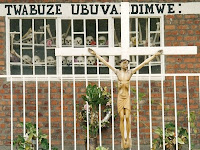
genocide memorialWARNING: VERY GRAPHIC

After sitting in on 2 small court trials of the Rwanda tribunal in Arusha, Tanzania, I wanted to tour a genocide museum or memorial in Rwanda. In 2003 this was not an easy thing to do. Most Rwandans had tried to put the past (the 1994 genocide) behind them. There were no huge signs saying "Look, the genocide was here!" There were only small reminders in select parts of the country. Even when I asked a couple of people if they could tell by looking at someone if he/she is a Tutsi or Hutu the response was always, "We are Rwandans."

To my surprise there was not anything like a museum or memorial in Kigali. My Lonely Plant guide book mentions 2 locations about 30-60 minutes south of Kigali. I asked the tourist information office in Kigali about this. The woman said there was a big memorial about 20 minutes north of Kigali. I told her I wanted to go. She said I needed to write a letter to some government group or organization. I needed written permission. She made it sound like it really was not an option for me.

Later while I was in Rugengari waiting to view the mountain gorillas, I met a New Zealand couple. We eventually discussed the genocide memorials. They said that they heard of a very big one near Butare, actually in a town about 26 KM west called Ginkorongo. It was not mentioned in the Lonely Planet travel guide but it was mentioned in a Japanese guide book. I thanked them for the information and said I would check it out once I got close to Butare.

Once I got to Butare I met a French woman, who helped me find a place to stay. It turned out that she was a professor. She came to Rwanda to do some research on the genocide. I told her I wanted to see a museum or memorial. She said that she knows a man who knew all the memorials in the country. He was staying in our same guest house. I should knock on his door and ask him. Later that day I ran into him. He gave me specific directions on how to get to the memorial near Gikongoro. The memorial is actually about 2 KM away in a place called Muranbi. I got all the information I needed and decided to head out to Muranbi the very next morning. The French woman warned me that maybe I should not go alone because it is psychologically very difficult. I was imaging Yad Vashem in Jerusalem but with visible bones around the grounds.

I took a minivan to Ginkogoro and began walking to Muranbi. The path was not straight. I stopped to ask directions 4 or 5 times. Eventually I hired a bicycle man to give me a ride the rest of the way. When I got off the bicycle I paid the man, gave him some banana bread, and asked him which direction to the memorial? He pointed forward towards the ghost town/abandon building. I really had no idea what I was going to see. With the help of the bicycle man I finally made it behind the first abandon building. Now I was on my own.
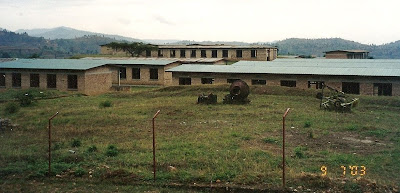
prison grounds

It looked like I was walking into a prison barracks but I was not 100% sure. There were metal bars that went around a bunch of buildings. This must have been where the containing fence was. There was also a big rusted spot light. It must have been used at night to watch for any prisoners trying to escape. I peaked in the first building expecting to find bones. I was trying to mentally prepare myself. I had no idea how I would respond. There was nothing in the room. I imagined it was a barracks with bunk beds and full of Tutsis in 1994. I moved on to the next room. Again, nothing. It was a little creepy being by myself. I started to listen to see if I could hear any ghosts of dead people milling around. Thank G-d--> nothing. I went into another building. It looked like it was where the toilets were. There were spaces for about 4 toilets.

clothes Next I found a huge empty hall like a dining room for prisoners. The only thing it had was a dozen hanging ropes full of clothes. They looked like old clothes. I really did not think someone was doing their laundry here but I wasn't sure. When I got closer I could see the clothes had dust and mold on them. These were probably from 1994 but I still was not 100% sure.

The next building I went into also had small rooms. For sure I was expecting to see some bones. I crept around the corner. Again, nothing. In one of the doorways there was some writing. It said "Dark room, Cell No. ?" Now I knew for sure I was at a prison. I started wondering where the gas chambers were or where the shooting lines were. There must be graves around somewhere. I went in search of the dead bodies and shooting line. Each building I looked into I saw nothing. I thought there must be something otherwise the French woman would not have said that this place was so psychologically difficult. Empty rooms could not be all. Some of the rooms were locked but that didn't make me suspect anything. Suddenly I heard voices. I turned around to see who was there. Again, it was a little unnerving being there all by myself.

Two men approach me. One puts out his hand to greet me. He has something metal in his left hand that I did not recognize. At first I thought, "Is it a gun? Is it a weapon?" I reach into my pocket to get my Swiss army knife ready. I watched carefully. He must have seen my eyes looking at it. He shook my hand. I recognized the other man as my bicycle man. He must have gotten this man for me. I followed him. He only spoke French. I could not ask any questions. I did determine that yes indeed this was a prison for Tutsis. The man took me to a room I had not seen yet. It was one of the locked rooms. He used the metal piece in his left hand to unlock it.

dead bodiesNow in front of my eyes were about 30 corpses lying on 4 wooden table like structures. I could see skin stuck to bone. Some skeletons had hair. Some had clothes and some had teeth. I had never seen anything like this before in my life. It was shocking. The most gruesome part was the position of the skeletons.


machetebroken legsWe went from room to room with the same twisted figures. Some young, some old, some men, and some women. I took several photos. I could see where machetes were taken to some skulls. A child's legs were broken. They were split apart.
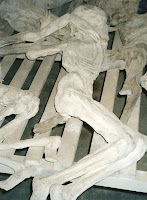

woman draggedA woman's hands were tied together and she was looking back at them in agony. Several children's heads were knocked against a wall.

Room after room I saw the same gruesome images. I held my breath as I entered each room. I decided I should breathe deeply at least once. It was important for me to know what death smells like. I inhaled and almost gagged. The odor was repugnant. I was not sure exactly what I smelled. I know some chemicals must have been used to preserve the skin and bones and teeth, but I did not know what. It did not really matter. It smelled awful and it was appropriate for the scene. After about 10 rooms of dead bodies, I said I had seen enough.

dead childrenThe man showed me one more room just of dead children. I looked, I took a picture, and I said finished. I then took one picture of the entire compound, a picture of bones that had been dug up, and one picture of some graves with flowers.
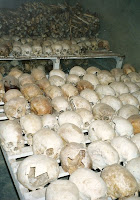
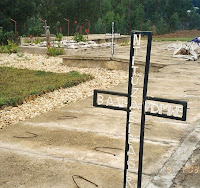
skullsgraves

My tour was over at this point. It was definitely more than I bargained for. I began to walk back towards Ginkorongo. Fortunately for me I met several happy children along the way that helped lift my spirits.

Friday, June 26, 2009

Zambia - Christian Prevalence

Zambian women and childrenI traveled through 10 African countries and my experience was that Zambia by far had the biggest Christian following. This caught me completely by surprise. The Christian prevalence in Zambia was so great that I felt uncomfortable voicing any other religious belief.

My first experience with the Christian influence in Zambia happened right at the border between Zambia and Botswana. As I was completing my paperwork to enter Zambia, I met a lovely American family. This was surprising because the only other Americans I had met in Africa to this point were in the Peace Corps. This family was not part of the American Peace Corps but were missionaries. I ended up hitching a ride with them from the border to Livingstone, Zambia. During the ride they told me they helped the people of Zambia in many ways. One thing they helped with was education. They taught the people of Zambia to read. They showed me some of the books they used. The books were at all different reading levels. Some had lots of pictures and others mainly text. The one thing these books had in common was that all the stories were about Jesus.

My second experience with the Christian influence in Zambia was on the bus ride from Livingstone to Lusaka. It was a 5 hour ride. Five minutes into the ride a man stood up immediately in front of me with a bible and began preaching. I was an unwilling captive audience for what could turn out to be 5 hours of what I thought was a bible wielding Jesus enthusiast. After 10 minutes of preaching I went to the front of the bus and asked the bus driver to turn on the radio. At first he did not hear me. I asked again but louder. I told him I did not want to listen to Jesus talk. The bus driver asked me what was wrong with Jesus. At that moment I realized that I should just sit back down. The man preached immediately in front of me for 1 hour straight. Then the bus driver turned on Christian music for the remaining 4 hours. This is when I began to realize the huge Christian influence in Zambia.

My third experience with the Christian influence in Zambia was on my village visit with a woman named Florence. Right before we were about to eat lunch, Florence's step father asked me my religion. Based on my experience with the missionaries and the reaction I got on the bus, I thought it best to reply Christian. Of course I was extremely conflicted over this entire situation, but I did not want to have a discussion on religion. Florence's step father then asked me to lead the prayer before the meal. I kept trying to remember what Pa or Laura Ingalls would say. The only prayers coming to my mind were the prayers over the Shabbas candles, wine, and challah said in Hebrew. I did not think this is what he had in mind. I thanked him but insisted that he do it. He kept pushing me to do it. Eventually Florence stepped in and said one. What a relief.

My fourth experience with the Christian influence in Zambia was by far my most over the top. It occurred on my bus ride from Lusaka to Chipata. As usual Christian music was playing. This time I knew not to request a change. About 2 hours into the 8 hour journey the music became unbearably loud. I was stuck between 2 people and could not get out to ask the bus driver to turn the music down. Eventually the bus stopped to let a woman out. The kind man sitting next to me got up to help the woman off the bus. I and the woman next to me asked the kind man to please ask the bus driver to turn down the music. We saw the man talk to the bus driver but did not hear any change in the volume. When the man sat back down next to me, I asked what happened. He said the bus driver refused. I could not believe this and was very agitated. The music was almost eardrum popping. A rude bus driver required rude tactics. I put 2 fingers in my mouth and gave a very loud and long whistle to get the driver's attention. Everyone in the bus looked at me. Then I stood up and started yelling at the driver to turn down the volume. Once again he did not. People on the bus were beginning to get annoyed. Another man got out of his seat and went to the front to confront the driver. They got into a heated argument. Again, the driver absolutely refused to turn down the volume. I was now starting to get nervous that we were going to get in an accident while the man and bus driver were arguing. Eventually the driver pulled off the road and stopped the bus. Now several passengers were on their feet asking for an explanation. The bus driver said there was a reason but it was none of our business. The man who went to the front yelled back to the driver that he is also Christian. Christian music was O.K. but just turn it down. The music remained piercingly loud for another 15 or 20 minutes before the bus driver turned it down. Later I found out the bus driver's reason. There had been several bus accidents on this route. He was superstitious and was playing the Christian music loudly to chase away the demons.

In no other African country that I traveled in did I come across such a strong Christian following. Some countries were split between Christianity and Islam. Most countries however had varying degrees of superstition and unique beliefs which were followed by his/her tribe or village.

Monday, June 15, 2009

Asia - Elephant Rides

male elephant Besides a distant viewing when the circus came to town and also a few times at the zoo, I had never been up close with an elephant. While in Asia I rode on the back of an elephant, once in Nepal and once in Thailand. Both rides were unforgettable but for 2 very different reasons.

From Katmandu, Nepal, I stopped off for a few days in Chitwan Park, which is on the way to the Nepal - India border. In Chitwan Park you can pick several activities to do from a list. I chose to visit the elephant reserve. There I saw lots of elephants of all ages and sizes. One of the big surprises was seeing a male elephant with ...(cough, cough)...his privates hanging out. Hung like a horse has a completely different meaning to me now. Let's just say it's all relative. The elephant's appendage was about the length of me -- about 5 feet...no exaggeration. Yes, I can now say that I have seen an elephant up close.

elephant foodgrazing elephantNot only did I learn about the anatomy of an elephant, but I also learned about the differences between the Asian elephant and the African elephant. The Asian elephant is smaller overall than the African elephant. The Asian elephant has smaller ears, one "finger" on the trunk, and only the male has tusks. In addition, I learned that elephants in general do not have very good digestive systems. Because the majority of what goes in the elephant's mouth comes out the other end, an elephant has to eat approximately 300 pounds of leafy vegetation each day. In the picture in the upper left the elephant handler is listening to music and relaxing on top of his elephant, while his elephant grazes. In the picture in the upper right the men are preparing snacks for the elephants.

elephant platformOn my second day in Chitwan Park I experienced my very first elephant ride. In order to get on top of the elephant, I climbed up a platform like a wooden jungle gym. I waited for the elephant to approach. Once the elephant was in place, I stepped onto the wooden "chair" that was strapped to its back. The wooden chair never touched the elephant's back. There was a big cushion of blankets between the elephant's back and the wooden chair. Once everyone was situated, the elephant walked us through the park.

mother and baby rhinosrhinos in pondAt one point the elephant used its trunk to clear away a low branch in the walking path. At another point we came upon a wonderful surprise. We found a mother rhino and its baby hidden in the long vegetation. The baby was suckling the mother. We also ran into 2 more rhinos. This time it was a male and female bathing in a pond. I could not have asked for a better elephant ride and animal viewing experience. Eventually we returned back to the large wooden platform and dismounted from atop of the elephant.

Thailand elephantsMy second elephant ride happened during my Chang Mai trek in Thailand. It could not have been more different from my experience in Nepal. The big issue for me was how I was to get on the back of the elephant. The handler wanted me to step on the elephant's face just above its eyes. It had been raining the day before and everything was muddy, including my boot. I did not want to put my muddy boot on its face. I just did not want to do it. The handler tried to explain that compared to the elephant I was very small and the elephant would barely feel me stepping on its face. I was still having a hard time shaking the fact that I was to put my muddy boot on its face and step up to the elephants back. Of course I was the only female in a group of 10 guys. The group was losing patients with me. Finally based on peer pressure I stepped up.

Abigail sitting on elephant Later on during the elephant ride the group got down to stretch their legs. I refused to get down. There was no way that I was going to step on the elephant's face again with my muddy boot. While everyone walked around, I hung out by myself on the back of my elephant. I do not recall seeing anything special. I just remember feeling bad for the elephants, especially since they had big heavy chains around their legs as well. These elephants had all been "broken in." This is a euphemism for they were tortured until they learned who was boss.

Since my 2 elephant rides in Asia, I have had numerous opportunities to view wild elephants in Africa. Although I am glad that I had the experience of riding an elephant, I prefer giving them some distance and letting them roam on their own terms.

Sunday, June 14, 2009

Tanzania - Biofuel

gas lamp In the past few years we have been hearing more and more about the need for alternative fuels. The reality is that we are starting to consume oil faster than we are discovering new sources. In other words, oil demand is outpacing supply. The development of alternative fuels is quickly becoming a necessity. One alternative that has caught a lot of attention is agrifuel, which is often made from corn, wheat, soybean, cassava, sugar cane, or palm. The truth behind agrifuel is that the cost associated with it far exceeds the benefit. Some of the biggest costs from agrifuel are:

  • deforestation to make room for growing these crops
  • starving developing countries of needed food
  • increasing water use to grow the crops
  • exploiting developing countries land to grow fuel needed in developed countries

There are many other alternative fuel options that no doubt have fewer costs and are overall more energy efficient.

manure mixturemanure down pipeWhile in Africa I came across an alternative fuel being used. Several homes were making use of biofuel. The source used for this biofuel was cow manure. A family's cows would be situated a couple of hundred feet from their home. The cow manure would be pushed to one location and mixed with water. All the big chunks of manure would then be tossed aside. The remaining liquid would flow into a pipe. The pipe would feed into a large underground tank.

tank While in the underground tank, the liquid would form a gas. This gas would run through the pipes running into the house. Anything in the tank that did not turn into gas would go out another hole and the remaining matter would be used as fertilizer.
gas stove
Once inside the home I could see the gas pipes, just like the thin gas pipes inside of an American home. In the evening the gas lamps would be lit to provide light inside the house (see 1st picture above). All meals were cooked on the gas stove. I happened to have enjoyed a cup of coffee made on the gas stove, which was made possible by the family's cows.

Recently a California dairy converted its big 18-wheeler trucks to run on biomethane produced from the dairy's cows. The Hilarides Dairy was featured in a February 2009 article and YouTube video on wired.com.

Although I am no expert on alternative fuels, I can only imagine that there have to be fewer costs associated with other fuels such as biofuel, wind, and solar than agrifuel. Cutting down trees, starving out developing countries, and increasing water consumption can not possibly be the best solution to our oil needs.